

Innovation distinguishes between a leader and a follower.
Walk into any leading online store in 2026, and chances are the engine driving its success has quietly shifted. Generative AI, once a futuristic experiment, has become the workhorse behind modern eCommerce. It is rewriting how businesses build, market, and scale their digital storefronts.
Those who lean into these AI advances are redesigning the shopping experience, from back-end development to the first words a shopper sees.
In fact, McKinsey estimates that generative AI could add up to $4.4 trillion in value annually, with significant impacts on areas such as marketing, sales, and customer service. Read on as we explore five ways generative AI in eCommerce is driving exponential growth.
5 Ways Generative AI Boosts eCommerce Conversions

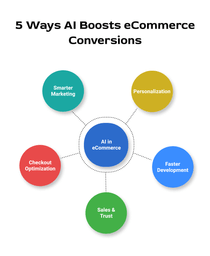
AI technologies make automation, content generation, smart analytics, and data organization easier.
Ecommerce brands can use these capabilities to improve customer service, optimize operations, and boost conversions in five impactful ways:
1. Development Moves Fast with AI
Building an online shop isn’t the plodding process it used to be. A few years ago, every product page update meant hours of repetitive copywriting.
Now, generative AI spins out detailed product descriptions and SEO tags in a fraction of the time, often capturing nuances that took human teams trial and error to nail down. The result isn’t just more copy; it’s sharper, on-brand storytelling across even the largest product catalogs.
Developers working on Shopify or WooCommerce stores have also caught the automation wave. With code suggestions, troubleshooting, and customizations generated by AI, projects move from idea to launch with less friction.
2. Personalization Becomes the Norm
Forget static lists of “related items.” Many stores now offer up suggestions that feel eerily accurate, thanks to AI engines that parse a user’s patterns and history in real time.
Enter a good store just once, and you’ll start noticing its recommendations picking up on the traces of clicks you’ve left behind: sometimes aligning with the very color, category, or style you chose on another occasion.
Chatbots may have once felt like mere response modules for canned FAQ-type queries. Today, they hear, learn, and actually fix real issues for customers at any hour, day, or night. This endless chain of assistance is not merely responding to elementary inquiries: it offers some semblance of companionship to an otherwise lonely shopper, regardless of when they arrived or what they pursued.
3. Smarter Marketing (and Less Guesswork)
In marketing, “gut feeling” is on its way out, and data is coming in to deliver precision. Now, generative AI would churn a handful of versions of a campaign, with each target-specific to an audience segment.
Designs, ad copy, and product visuals remain agnostic of one another and are tuned in bulk, thus making it more nimble and less reliant on long feedback cycles.
Testing, too, is less of a headache. Automated A/B testing tools powered by AI turn around winning creative combinations without requiring a team of analysts watching the numbers.
4. Real Improvements at Checkout
Conversion rates are often the result of tiny adjustments, and generative AI may now be implemented to reach the maximum conversion.
Dynamic pricing tools keep prices adjusted in relation to market fluctuation. In contrast, predictive analytics anticipate what a customer would want next: offers bundled together, upsells, or promotions sent at just the right moment.
Inventory headaches are starting to fade, too. Algorithms predict demand before products run out or sit too long on digital shelves. By matching stock to demand, stores trim excess costs and keep popular items available.
UI/UX design has its own role to play in smoothing out the checkout process— something that experts can help you achieve seamlessly.
5. Boosting Sales & Conversions
Not all problems are technical in the presence of strong AI for eCommerce sales; the data-privacy mantle looms large, with innovative eCommerce brands emphasizing strong controls over customer information.
The shopper needs to be entirely clear on data use from their side. A leading business-building trust keeps its policies updated, follows transparent communication, and makes sure it complies with changing regulations.
There’s a fine line between automation for efficiency and impersonal treatment. Trust is still hard-earned. On this note, teams must regularly monitor the output of AI in online store development, tailor it to their brand voice, and be prepared to intervene whenever necessary.
Challenges & Best Practices
Generative AI can accelerate growth, but its impact depends on how responsibly it is implemented.
Two major challenges stand out, along with practical ways to address them:
1. Protecting the Privacy of Customers’ Data
Customers are increasingly aware of how their information is collected and used. Strong security protocols, clear communication, and compliance with regulations are essential. Businesses that make privacy part of the overall customer experience, rather than a back-end obligation, build deeper trust and loyalty.
2. The Hybrid Approach: Automation and Human Connection
It is of speed, scale, and personalization that AI delivers; yet marketing experiences do sometimes feel impersonal if AI is the sole alternative considered. The best solutions come from marrying the efficiency of AI with human intervention.
Reviewing AI outputs regularly, ensuring consistent brand tone, and applying empathy in customer contacts—all help the business to create experiences that are smooth yet authentic.
The bottom line: Companies that couple AI innovation with responsible practices not only avoid slipping into risk situations but also strengthen customer relations and long-term brand allegiance.
Turn Your Website Into a Conversion Powerhouse with Centous
Generative AI isn’t a fad. It’s reshaping how digital stores are built, promoted, and optimized, sometimes so thoroughly that even experienced teams are surprised by what’s possible.
At Centous, we complement this transformative technology with a comprehensive digital marketing approach tailored to each business’s unique needs.
Our expertise spans SEO, technical SEO, email marketing, social media, PPC management, and campaign monitoring, ensuring every element of your strategy drives engagement and boosts conversions.
Want to adopt generative AI in eCommerce for your store? We’ve got you covered. We can help you integrate AI solutions into Shopify and WooCommerce to unlock personalization, automation, and growth.
So why wait? Partner with Centous to turn your website into a high-performing sales engine!